
One Life, Many Loves


The word 'libido' originates from the Latin word libere which means both; to please and to be free. This ties in very well with the 4 Purusharthas of Hindu philosophy: Dharma (one's duty to the self and society), Artha (meaning and money making), Kama (enjoyment, passion and sexual desire) and Moksha (liberation). Technically, Moksha is not even considered a proper goal because it arises as the result of finding complete satisfaction in oneself to the point where we begin to rejoice in our own nature. There is a reason why Kama comes before Moksha because a complete acceptance, refinement and enjoyment of our libidinal desires is what leads us to realize that the joy of engaging them actually comes from within and one does not need an external source. In fact in Tantric philosophy we have the concept of 'samsakaras' which are psychological imprints or desires —traces that must be brought into awareness and ultimately dissolved.
Sigmund Freud, the father of psychoanalysis, describes this libido as the 'life-instinct' and explains in his theory of psycho-sexual development that the libido is actually diverse because one focuses this life instinct on pleasing particular parts of their body through out their life.

This is a very simplistic explanation of the theory but what I want to focus more on is the term 'diversification of the libido'. Freud believed all sorts of neurosis arise from not being able to fully express one's libidinal energy and to obsess completely one just one object or person; things that may or may not waver and might put you in the state of mental collapse quickly because you poured your life force into it. I've said this before in the previous Eros article, our problem is not a lack of love but a very narrowed perspective of it. Love as fixation can be very harmful because it then becomes chained to something outside of yourself.

In tarot too, the Devil and the Lovers are constantly compared, if we look carefully, the gaze of the demonic entities is locked in on each other, that is why they feel the chains of love. However, in the Lovers, the feminine (creative, cooling and lunar principle) is looking up to the angel. She also has a serpent behind her to represent the Kundalini that is always seeking to unite with Shiva and her lover (masculine, solar and heating principle) represents the flames of passions that he ignites within her in order for her to lead the way to liberation.
Eros however is an uncontrollable, fleeting and invisible force (both in Greek and Hindu mythology) and has the power to cause extreme chaos. In Greek mythology, Psyche (soul, moon, spirit) is unable to see Eros because he believes that he will not be truly loved for who he is if he becomes visible. Psyche has to go through a lot of trials in order to see her husband and be united with him. Similarly, it is Shiva who burns away the physical form of Kamadeva (who is then revived by Parvati, who is very similar to Psyche as She does immense penance for Shiva) and purifies Him so that love does not remain in the physical, fixed form but actually becomes subtle and pervasive. This is also why both Eros and Kamadeva are with wings. Much like bees that gather nectar from many flowers to produce a richer honey, the psyche deepens its capacity for love when it is not confined to a single source of sweetness.

Enter Shiva, a complete paradox; neither an ascetic nor someone hedonistic. Shiva means 'auspicious' (quiet similar to Sri) because it is auspiciousness only in which non-duality can exist. All desires emerge, sustain and dissolve in Him because He is the field that can contain everything without conflict or suffering. There's often a metaphor of the movie theater goer used for Shiva-Shakti. Shakti is the movie playing in front of Shiva's eyes and He's aware that it is Her play which is why He's able to enjoy it without getting destabilized by it. Let's look at Shiva's imagery.
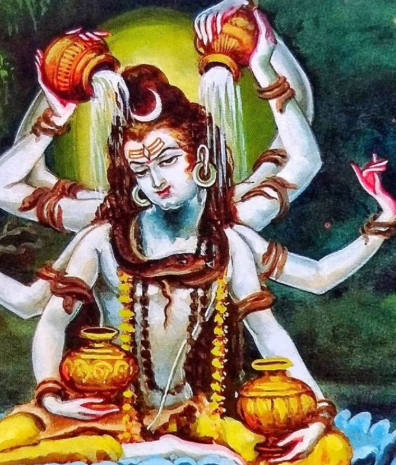
The moon is never constant; it waxes, wanes, disappears, and returns. In the same way, our emotional and libidinal life is not singular or stable. We are not meant to feel one thing forever, nor to be devoted to only one expression of love. Yet most people are unable to withstand this constant change. They either cling to one phase or become overwhelmed by the movement itself. Shiva does neither. As the perfect yogi, Shiva wears the Moon like an accessory: the fluctuations are simply an adornment, an excitation but do not define Him.
From his matted locks flows the river Ganga, whose descent would otherwise shatter the earth. Uncontained, she is overwhelming, destructive, excessive. But through Shiva, her force is regulated, softened, made life-giving. Desire functions in much the same way. When it floods the psyche without structure, it leads to compulsion, fixation, and eventual exhaustion.
This is why Shiva burns Kama. Not to destroy love, but to transform it. Kama, once embodied and directed toward specific objects, becomes Ananga—the bodiless one.
To live with many loves, then, is not to endlessly seek new objects of desire, but to cultivate the capacity to let desire move freely without becoming bound to any one of its expressions. It is to allow attraction, curiosity, and passion to arise in many directions without clinging and fixation. However, this capacity is not natural to many and a lot of people tell me it is difficult to sustain focus on multiple passions.
The feminine in these myths become refined by the fire of love ignited within them and do deep work in order to attain union. The feminine principle of Parvati and Psyche exists within all of us as our ability to remain focused on our goal. Psyche must undergo trials, learning patience, discernment, and endurance before she can truly unite with Eros. Similarly, Parvati does not win Shiva through mere longing. She performs tapas until she becomes equal in depth to the one she loves.
To have many loves in one life is not simply about being open or curious. It requires the ability to direct attention, to return to what matters, and to remain engaged without becoming dependent on any single source of fulfillment.
At any given point, a person can have one central area of focus and a few secondary forms of engagement. The central focus provides continuity and direction. The secondary ones allow movement, variation, and renewal. These can take different forms. Intellectual work, creative practice, physical discipline, relationships, and sensory or aesthetic pursuits. The key is not intensity but consistency. Not everything has to be pursued at the same time or with the same depth, but each form of engagement should be revisited regularly. This allows interest to deepen over time without becoming rigid.
Tithis: Half-lunar days

In Vedic astrology, the lunar cycle is divided into tithis, each carrying a different quality of energy. Rather than treating each day as identical, these cycles can be used to guide how one engages with different forms of attention and effort.
Certain tithis are more suited for initiation and outward movement, while others support reflection, refinement, or withdrawal. Some are associated with clarity and decisiveness, others with emotional processing or subtle internal work.
When understood in relation to one’s chart, especially how different planetary energies function for the individual, this creates a way of distributing effort more intelligently. Instead of forcing the same kind of focus every day, one begins to align different forms of engagement with different energetic conditions.
For example, days influenced by more active or assertive planetary energies can be used for outward work, decision-making, or physical action. Days with softer or more inward qualities can be used for creative work, study, or emotional processing. Over time, this creates a cycle where multiple interests are not competing with each other, but are given space at different points.
This does not require strict adherence or rigidity. The purpose is not to control every action, but to introduce a rhythm that allows attention to move in a more fluid manner.
If this framework resonates, it can also be applied in a more personal way.
Each person’s relationship with attention, desire, and timing is shaped differently by their chart and lived patterns. The same cycles do not feel identical for everyone, and the way eros moves through a life is always specific.
(In my readings, I work with this intersection of astrology, timing, and lived structure to understand how different phases of life can be organized more clearly. If you want to explore your own rhythms in this way, you can reach out for a reading.)
Entirety exists within me as exuberance in empty longing in the desire to burn with desire. -Georges Bataille


Comments