
Eros, Interrupted 🏹
- Siddhi Vyas
- Feb 12
- 5 min read


We're not impoverished for desire, in fact, modern society and the Goddess's deluding power creates an excess of desire. But just because something is in an excess, doesn't mean that it is of exquisite quality and invokes true erotic power.
Recently, a tweet by user @maryaamsss_ on X reignited an old debate about love, lust, and desire. The post read: “Men in love don’t see their women with lust btw.”
The sentence is deceptively simple. It divides the world neatly: love on one side, lust on the other. It is also something religious leaders and inexperienced internet gurus have been preaching for long. Hinduism on the other hand, posits a different view about the nature of Eros and how one needs to engage with it mindfully, like an act of devotion and be able to see all of its different hues.
Kameshwara-Kameshwari
In the Kalika Purana, it is said that Brahma first gave birth to Kamadeva. Desire was the first born in the world. Before preservation, before destruction, before order, there was longing. And Kamadeva had a boon that he could not be defeated by anyone. Not Vishnu, not Shiva, not even Brahma himself. It was invincible.
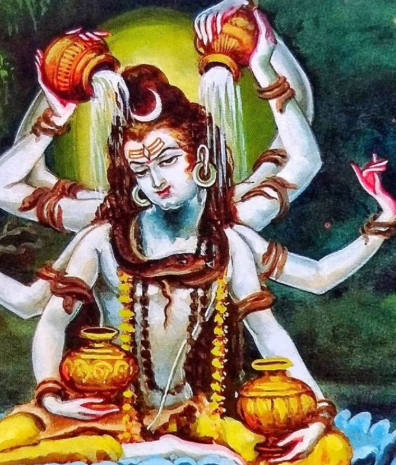
When Sati took rebirth as Parvati, She knew that Shiva, absorbed completely within himself, would not be moved by devotion alone. He was the most detached of yogis, cold in his self-sufficiency. So, She turned to Kamadeva, because he alone had the power to stir even the most withdrawn consciousness. Kama drew his bow and released his arrow, the arrow struck. A stirring birth within Shiva, in that first movement of awareness toward another, duality was born and creation began as a result of it.
But to desire is also to experience separation. When Shiva felt that pull toward Parvati, He experienced himself as divided. And in that unbearable recognition of separation, He opened his third eye and burned Kamadeva to ash.
From the ashes of Kamadeva arose Bhandasura, the one who dries out the world of its juice, its beauty, its erotic vitality. Under his reign, the Devatas became distressed. The world lost its lusciousness, it resembled Shiva; dry, detached and ghostly. Bhandasura quite literally means the unfortunate one and it is misfortune to inhabit a world emptied of rasa.
In their desperation, the devas conducted a fire sacrifice and entered the sacrificial fire themselves. They cut off their own parts and offered them into the fire of Eros. Through that act of total offering, Lalita Tripurasundari was born!
She restores and transforms Bhandasura back into Kamadeva, back to the original glory but this time without a body. Ananga. Desire without crude limitation, boundless and pervading everything that exists. The secret of this is if Kama cannot be seen or put in a form, He cannot be destroyed due to the limitations of physical forms. Devi makes it so that He's turned into winds and the arrival of spring, He then obviously becomes eternally devoted to Her and worships Her in Kanchipuram as Kamakshi (She whose eyes create Kama/love/passion).

Like I mentioned in the beginning, we're not suffering from a famine of passions, but we are also not letting ourselves completely throwing ourselves in the sacrificial fires to the most Beloved so that we can experience Eros in all of its beauty. Georges Bataille describes eroticism as 'assenting to life up to the point of death' and this is clearly shown by the valour and bravery of the devatas who are willing to plunge themselves for they know they have to completely give up their old identities in order to bring back rasa and lusciousness back into the world.
If we look closely, our patterns of consumption have quietly reshaped our experience of eros.
There was a time when watching a film meant entering a dark room filled with strangers, laughing, being moved and experiencing art together. It required stepping out, dressing up, making an evening of it. It's the same with going to a restaurant and enjoying a meal, such a deeply seductive activity. Thanks to streaming platforms and delivery applications, now you don't need the extra steps, and desire becomes your servant and pleases you in your own home. Convenience culture starves Eros when isolated from others. The reason why society becomes Eros-repulsive is because in the modern day, it looks like one needs to be predatory, selfish and grossly self-obsessed to indulge in it. However, true erotic power is not about taking something from another --It is about losing something of yourself. Losing certainty, rigid identity and this need to hold on to the self.
That is why it feels dangerous, to love and desire is to be changed and consumed which is why it is much safer to consume in private, to scroll endlessly and let the parasitical nature of capitalism feed on you mercilessly.
Eros maybe interrupted now, but it never completely disappears for artists and lovers exist and keep fanning those flames and sacrificing themselves in the fire.
Bali Devata: Sacrificing yourself at the altar of Eros

In my article about Kurukulla Devi, the deity of Sri Vidya who is the consumer of all sacrifices, I talk about the form of Kurukulla and what She does when entering the worship of Lalita. Her imagery suggests that in order to truly immerse yourself in the beauty of Sri Vidya, you must be pierced by Her arrows of love. It's often said that Kurukulla (sacrifice of the ego), Matangi (changing the narrative about duality) and Lalita (playful and orgasmic union with the divine) are the same deity because they all evoke the power of Eros within one.
Kamadeva's final goal is not physical orgasm or even to make you fall in love with another; it is actually to make you fall in love with the play of the Goddess and enjoy the lusciousness of the world as it is.
Kamadeva does not limit desire only to the bedroom, in fact, the season associated with Him is that of Spring. When flowers are abloom, when the wind is just the right amount of cold and the Sun is getting warmer, opening us up to go out and experience nature more. How can we limit Eros to exploitation or say that one needs to be devoid of any warmth or fire in order to experience true love?
Kama is actually the final goal (purushartha) of human life, moksha is not in our hands but solely the deity we worship. However, the thing about Kama is that it requires a real vira (brave one) to truly enjoy it without feeling hurt or confused by it. In the Lalita Sahasranama, many names of the Goddess are associated with the viras for this reason. To play and enjoy without the fear of 'not getting something' out of the play but to play for the sake of it is what real bravery is. Think of children in a playground, they're not thinking they're wasting time or need to win sliding down a slide --it's just a simple, aimless joy.
Kamadeva, Kurukulla or Cupid point their arrows, ready to go at anything just to make people or things to fall in love and become 'injured' by desire. Injury by desire is necessary because it builds immunity and a greater inner capacity for love in all of its shades... and when you begin to see everything as love, the presence of God itself, you're instinctively liberated.


Comments